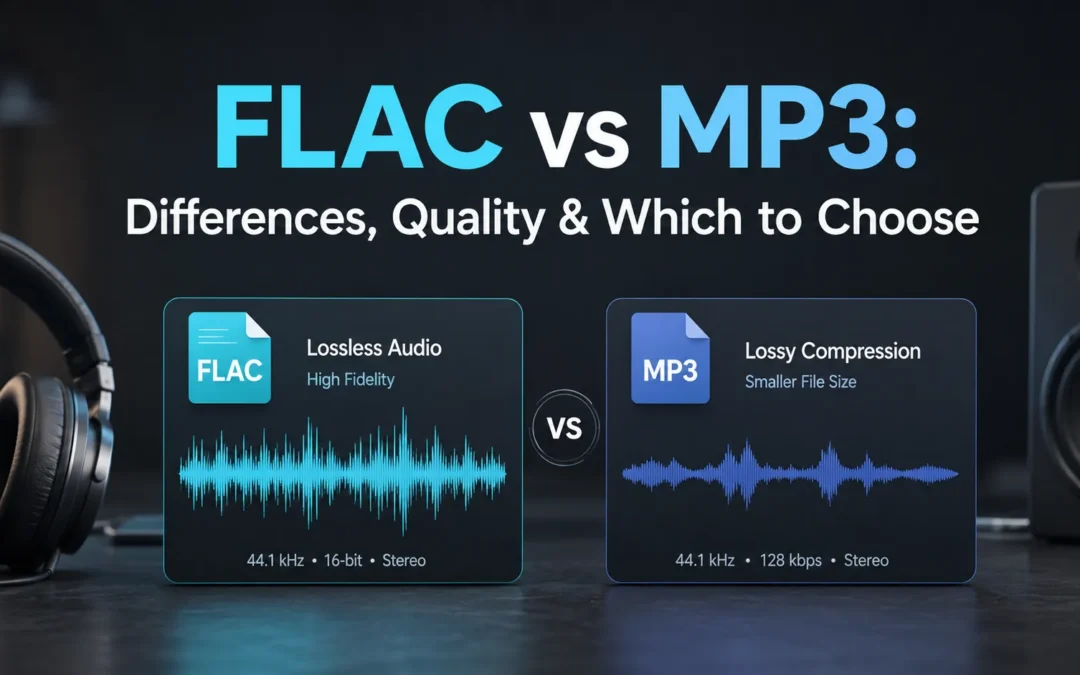
You just dropped $300 on a pair of headphones. You’re streaming music, and it sounds fine. But somewhere in the back of your head, a question keeps nagging. Are my files holding me back?
It’s a fair question. And the answer is probably not what you expect. The FLAC vs MP3 debate has been running for years, mostly in circles. Most of what you’ll read lands somewhere between “FLAC is objectively better” and “just use whatever.” Neither is actually useful. So let’s get specific.
What is FLAC?
FLAC stands for Free Lossless Audio Codec. It was developed by the Xiph.Org Foundation and released in 2001. The “lossless” part is the whole story.
When you compress audio into FLAC, no data gets thrown away. The algorithm finds redundancies in the audio signal and encodes them more efficiently, but when you play it back, the output is bit for bit identical to the original source.
Think of it like a ZIP file for audio. The file gets smaller but nothing inside is missing. Typical FLAC compression reduces files to between 50 and 70 percent of their original size compared to uncompressed formats like WAV or AIFF.
A raw CD quality WAV track might be 50 MB. The same track in FLAC sits around 25 to 35 MB. All the original data, meaningfully less space, though not the dramatic shrinkage lossy formats achieve. That difference is the entire tradeoff this article is about.
FLAC supports high resolution audio up to 32 bit depth and sample rates up to 655 kHz, well beyond what any human ear can process. It also supports embedded metadata cleanly, which matters for large music libraries.
What is MP3?
MP3 was developed by the Fraunhofer Institute in Germany and became the dominant audio format through the late 1990s and 2000s. It’s a lossy format, meaning compression works by permanently discarding audio data.
The keyword is permanently. Once you encode a file as MP3, what’s gone is gone. MP3 achieves its file size reductions through psychoacoustics, which is the study of how humans perceive sound.
The encoder identifies frequencies that are harder for the human ear to detect, sounds masked by louder sounds or outside our typical hearing range, and removes them. The result is a smaller file that sounds, to most ears, close to the original.
Bitrate is the main quality variable in MP3. It’s measured in kilobits per second (kbps):
- 128 kbps: Small files, audibly degraded to most listeners
- 192 kbps: Noticeably better, acceptable for casual listening
- 256 kbps: Good quality, hard to distinguish for most people
- 320 kbps: The maximum standard MP3 bitrate, very close to lossless for most listeners on typical gear
A 320 kbps MP3 of a 4 minute track comes in around 9 to 10 MB. The same track in FLAC is roughly 25 to 35 MB. That’s a 60 to 70% size reduction.
FLAC vs MP3: The Core Differences
| Feature | FLAC | MP3 |
|---|---|---|
| Compression type | Lossless | Lossy |
| Audio data preserved | 100% | Partial |
| Typical file size (4 min track) | 25–35 MB | 4–10 MB |
| Max quality | Original source | ~320 kbps |
| Bit depth support | Up to 32 bit | Up to 16 bit |
| Sample rate support | Up to 655 kHz | Up to 48 kHz |
| Device compatibility | Good, not universal | Near universal |
| Streaming use | Tidal, Qobuz, Spotify Premium | Spotify, most platforms |
| Reencoding quality | Stays lossless | Degrades each time |
Can You Actually Hear the Difference between FLAC vs MP3?
Here’s where most guides lose the plot. They confirm FLAC is technically superior and leave you to assume you’ll notice it. The reality is a lot messier than that.
Human hearing has hard limits. Most people can’t detect frequencies above 20 kHz and that ceiling drops with age. Unless you’re 19 and haven’t discovered loud concerts yet, those ultra high frequencies are basically inaudible.
The psychoacoustic models that MP3 uses were designed specifically around these limits. A well encoded 320 kbps MP3 removes frequencies that, in most listening contexts, you were never going to hear anyway.
ABX testing is the most honest way to evaluate this. In an ABX test, you listen to track A, track B, and track X, which is secretly either A or B. You have to identify which one X matches.
Studies consistently show that most listeners, even self described audiophiles, score near chance when comparing well encoded 320 kbps MP3 to FLAC on standard consumer equipment.
The most rigorous public versions of these tests have come from the Hydrogenaudio community, which has run structured blind listening tests on lossy encoders for years.
The consistent result: at high bitrates, listeners score barely above 50% accuracy, essentially a coin flip, when asked to pick the lossy encode out from the lossless original.
There is also a famous formal study published in the Journal of the Audio Engineering Society in 2007. Meyer and Moran inserted a CD-quality conversion loop into high-resolution audio playback and ran over 500 blind trials asking listeners to detect it.
Detection rates landed at chance. That study compared high-resolution audio against CD quality rather than MP3 against FLAC, so it is a neighboring comparison rather than this exact one, but it demonstrates the same underlying point: once audio passes the threshold of human hearing, better numbers on paper stop producing audible differences.
This is not a comfortable finding for the audiophile community. But it holds.
But I know that talking about something is one thing, and actually hearing it for yourself is a whole other thing. So below, you can listen and compare for yourself.
Included here are both an MP3 version and a FLAC version of Kimiko Ishizaka’s performance of J.S. Bach’s Goldberg Variations, BWV 988 — Variatio 29 a 1 ovvero 2 Clav.
Listen to both versions and see what you think. Do you hear a difference?
MP3 Sample Audio
Download Variatio-29-320kbps.mp3
FLAC Sample Audio
Download Variatio-29-FLAC.flac
Both files were converted from the same 24-bit, 96 kHz WAV source file and converted to 48 kHz stereo. The FLAC version is 24-bit and lossless, with an average bitrate of about 1,198 kbps. The MP3 version is lossy and encoded at 320 kbps CBR.
FLAC vs MP3: Hardware Differences
Here’s the thing most format comparisons skip entirely. Your ability to hear any difference between FLAC and MP3 is almost completely determined by your playback chain.
That means your headphones or speakers, your DAC (digital to analog converter), and your amplifier. On a $20 pair of earbuds, the format is irrelevant. The driver quality, frequency response limitations, and ambient noise will swamp any difference in the source file.
On a well matched system, a dedicated DAC, quality headphones like the Sennheiser HD 600 or Beyerdynamic DT 990 Pro, and a clean amplification path, some differences between poorly encoded MP3 and lossless audio become more detectable.
Particularly in complex passages with a lot of simultaneous frequencies, where MP3’s masking algorithms make more aggressive decisions. But even then the gap between 320 kbps MP3 and FLAC is much smaller than most people assume going in.
The practical effect: if you haven’t invested in a decent DAC and quality headphones, spending hours converting your library to FLAC is solving the wrong problem.
If you have money to spend on better sound, I would put it toward headphones and a DAC before I spent a single evening re-ripping a music library.
FLAC vs MP3: File Size and Storage
A 1,000 track library in FLAC at average track lengths takes up roughly 25 to 35 GB. The same library in 320 kbps MP3 is around 8 to 10 GB. Streaming services have largely made local storage debates less pressing for casual listeners but for people who travel, use offline modes, or have data caps, file size still has real consequences.
FLAC also doesn’t play everywhere. Apple’s Music app and iTunes don’t support FLAC. Apple uses its own lossless format, ALAC (Apple Lossless Audio Codec), which matches FLAC in quality but fits the Apple ecosystem.
You can play FLAC files on an iPhone through the Files app or third-party players, but you cannot bring them into your Apple Music library without converting first.
Car stereos vary widely. Some read FLAC from USB, many don’t. MP3 plays on almost everything built in the last 25 years. Hard to beat that.
FLAC vs MP3: Bitrate and Psychoacoustics
Bitrate isn’t the only variable. Two 192 kbps MP3s encoded with different software can sound noticeably different from each other. The encoder matters.
The Fraunhofer MP3 encoder and LAME (the most common open source encoder) both produce different results at the same bitrate settings. LAME’s variable bitrate modes often sound subjectively better than constant bitrate encoding at the same average bitrate, because the encoder allocates more bits to complex sections and fewer to simple ones.
If you are archiving in MP3 at all, VBR settings like V0 are worth understanding before you commit a whole library.
The Nyquist-Shannon Sampling Theorem is the math behind why CD quality audio (44.1 kHz sample rate, 16 bit depth) is sufficient to reproduce all frequencies in the human hearing range.
The theorem states that a sampling rate must be at least twice the highest frequency you want to capture. Human hearing tops out around 20 kHz, so 44.1 kHz samples are theoretically complete.
FLAC vs MP3: Streaming
This conversation changed significantly in 2021 when Apple Music added lossless and hi res lossless audio at no additional cost. That raised the stakes.
Current streaming quality tiers:
- Spotify: OGG Vorbis up to 320 kbps on standard quality, with lossless FLAC up to 24-bit/44.1 kHz now rolling out to Premium subscribers at no extra cost
- Apple Music: AAC at 256 kbps standard, ALAC lossless up to 24 bit/192 kHz
- Tidal: FLAC lossless and hi-res FLAC up to 24-bit/192 kHz included in its standard subscription. Tidal phased out MQA in 2024 and replaced it with FLAC across the catalog
- Qobuz: FLAC lossless and hi res FLAC
- Amazon Music: Up to HD (lossless) and Ultra HD (hi res) on Amazon Music Unlimited
Apple Music’s decision to include lossless by default effectively removed the cost argument for lossless streaming. If you’re on Apple Music, you’re already getting lossless whether you think about it or not. Whether you can hear it is still the relevant question.
FLAC vs MP3: Use Case
Use FLAC when:
- You’re archiving a music collection long term and want to preserve source quality for potential future reencoding
- You’re mixing or mastering audio and need lossless working files
- You have a high end home listening setup with a dedicated DAC, quality amplifier, and reference headphones or speakers
- You’re sourcing from lossless masters for production work
Use MP3 when:
- You’re loading music onto a mobile device with limited storage
- You’re sharing files where compatibility matters more than quality
- You’re encoding for background music in a video, podcast, or presentation
- You’re listening on earbuds, laptop speakers, or in a car with ambient noise
- Your playback chain can’t realistically resolve the difference anyway
The practical middle ground:
Keep FLAC masters for your archive. Transcode to 320 kbps MP3 or V0 VBR for mobile use. You get the best of both without committing 35 GB to a phone library that plays back through a Bluetooth speaker.
This is the setup I actually run. The archive lives in FLAC, everything that goes to a phone gets transcoded to 320 kbps, and I have never once regretted either half of that decision.
For the wider landscape beyond these two formats, including AAC, Opus, and WAV, see our guide to the best audio format in 2026.
Should You Upgrade to Lossless Streaming?
If you’re already on Apple Music, you’re already there. No action needed. For other platforms, the upgrade is worth evaluating on two conditions: your hardware and your listening habits.
If you’re listening on AirPods on a commute, lossless streaming adds bandwidth cost and battery drain with no perceptible benefit. Bluetooth re-compresses the stream with its own lossy codec before it ever reaches your ears, so the lossless file never actually survives the trip intact.
If you’re sitting at a desk with a dedicated DAC, quality headphones, and a quiet room, there’s a reasonable case.
Tidal and Qobuz are the most serious dedicated lossless streaming options currently available, and with Spotify and Apple Music now including lossless in their standard subscriptions, the price gap that once justified skipping lossless has mostly disappeared. Whether a dedicated service is still worth paying for comes back to the same gear and ears question. Test both with a trial period before committing.
Frequently Asked Questions
Is FLAC better than MP3?
Technically yes. FLAC preserves all original audio data; MP3 permanently removes portions of the signal during encoding. In practice, whether you’ll hear that difference depends almost entirely on your playback equipment. On standard consumer gear, a 320 kbps MP3 and a FLAC file of the same track are indistinguishable to most listeners in blind tests.
Can you hear the difference between FLAC and MP3?
At low MP3 bitrates (128 kbps or below), most people can. At 320 kbps, research consistently shows that listeners score near chance in blind ABX tests when comparing to FLAC on typical consumer equipment. High end systems with dedicated DACs and quality headphones make differences more detectable, but still not universal.
Why are FLAC files so large?
FLAC uses lossless compression, meaning it preserves all original audio data and can’t discard anything to reduce size further. A 4 minute track in FLAC sits around 25 to 35 MB because it contains the complete audio information from the source recording. MP3 achieves smaller sizes by permanently removing audio data the encoder predicts won’t be noticed.
Is 320 kbps MP3 good enough?
For most listening scenarios, yes. At 320 kbps, the psychoacoustic compression is subtle enough that blind tests show most listeners can’t reliably distinguish it from lossless. It’s a meaningful step above 128 or 192 kbps. If you’re not running high end playback equipment in a quiet environment, 320 kbps is practically indistinguishable from FLAC for the majority of listeners.
Which format is best for streaming?
It depends on the platform and your hardware. Apple Music and Spotify Premium now include lossless at no extra cost, and Tidal includes hi-res FLAC in its standard subscription. Qobuz remains the dedicated hi-res specialist. For most listeners on typical gear, standard quality streaming at 256 to 320 kbps is sufficient. Lossless streaming adds value mainly when you have the equipment to resolve the difference.
Can converting MP3 to FLAC improve audio quality?
No. Converting a lossy file to a lossless container doesn’t recover the data that was discarded during the original encoding. You end up with a larger file holding the same degraded audio. If you want lossless quality, the source file needs to be lossless from the start. Reencoding in any direction from a lossy source only maintains or worsens quality, never improves it.